Selected Works
How to Become a Sunflower
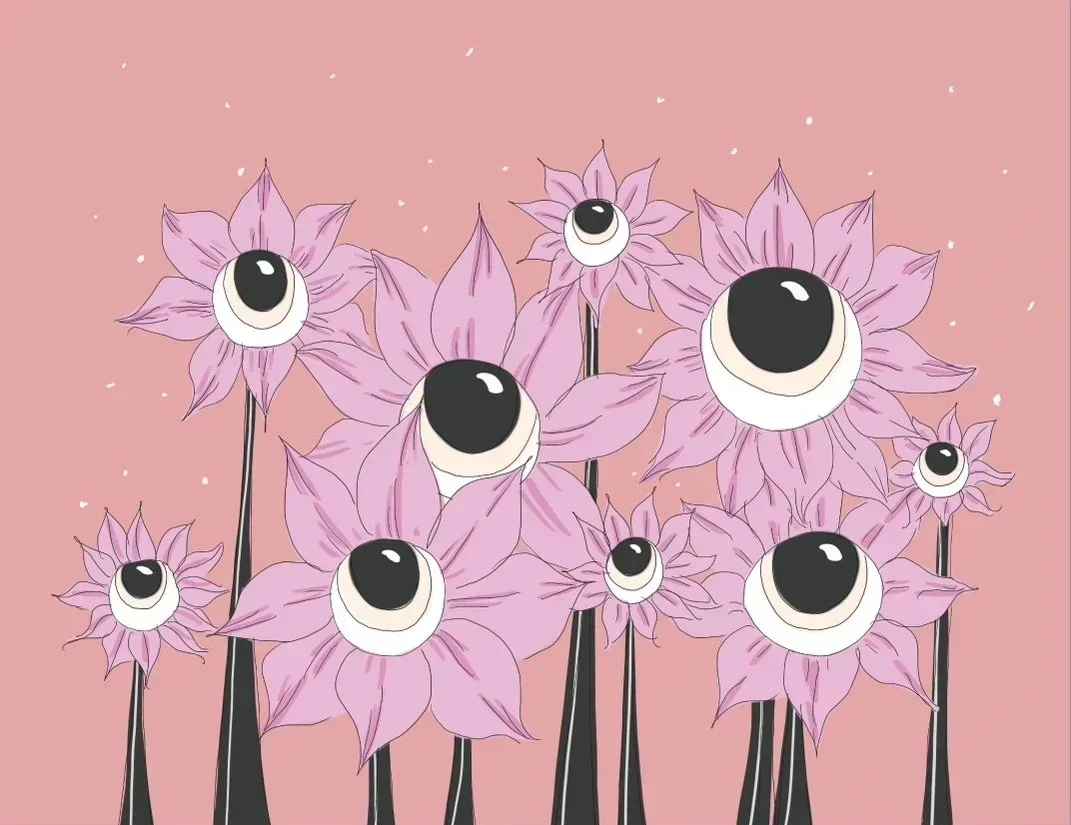
When I was younger, I wanted to grow up to be a sunflower. We grew them in our shady, little backyard among gravel and patchy grass. I don’t know how they survived in those conditions, but they grew just tall enough to face the glowing Sun. I’d spend quiet afternoons lying underneath them, admiring their towering stalks and fluttering leaves. Kid wonder, rosy face, and sunkissed cheeks. They danced in the wind and I danced with them. They tucked their heads at night and I curled up beneath them. I peered into their spiraled black eye, and they stared back at their pupil. A garden of guardians who could teach me to be taller, brighter, mightier. What more does a little girl need than to learn how to find the Sun? They sang, My girl, we will show you how to become a sunflower.
A bouquet of sunflowers sit at the base of a hospital bed. They were never meant to be there.
My cadaver lies in the dirt among dying calendulas. It’s a beautiful day. A few clouds retreat west, leaving a cloudless sky as the air fills with a quiet nervousness. Crickets click like a heartbeat and the Earth breathes all at once. Intertwining vines wrap around me and I wear them like intravenous jewelry. My foot blooms black and blue, a deadly and deathly flowering mass. Mold and moss grow over my bones as if discolouring tree limbs. I can barely feel my toes. My luminescent skin simmers in the full wrath of the heat. I can barely open my eyes. I sunbathe in radiation, letting multicoloured sun rays through my grass stained veins. Death is a force of nature.
A team of doctors outline a nine month treatment plan. I come to understand that the hurt is the healing.
Don’t be afraid of the pain, the sunflowers say. It means the bad parts are dying. Snakes shed dead skin when they’ve grown into a new one. Caterpillars entomb themselves so they can emerge as butterflies. Two-way growing pains. I make myself as sick as possible as an act of survival, of self-love. Try to salvage roots by digging myself into the dirt. Enter the race to see which part of me the medicine kills first.
I don’t trust my body. How could I when it’s betrayed me so many times?
What doesn’t kill you makes you stronger, the sunflowers taunt. My body grows weaker. Blossoming weeds sprout like pretty little malignancies. Carnations reincarnated into parasitic spores. Cell propagation gone wrong. I kill it all at once. We’ll go down together.
I meet with my surgeon to discuss the procedure.
Schoolchildren stand in a circle in the field of sunflowers and dare each other to cut off more of their limbs. I gather blades of grass, rose thorn scalpels, lie down on a foliage surgical table, and cut into my skin. All the birds scream. Red spills like first rain. I welcome the pain. In the place where my limb used to reside, between the healing stiches, grows a young sunflower. I try to wriggle my toes and in their absence find pins and needles. Bloody branches and torn tree limbs rest scattered among the sunflowers. Cut the stems and I’m a bouquet at the base of a hospital bed. Still not dead.
I fell in love with the pain, but it didn’t love me back.
The hurt doesn’t help you anymore, the sunflowers whispered. You’re all healed now. But poison was the medicine once before. I reopen wounds thinking it will help the skin grow over. Picking petals feels like penning a love letter to myself. She loves me. And I can’t help it. I can’t help because I had to learn to love it.
And no, I’m not afraid of dying.
I died once already. Death isn’t so scary when you face it everyday. Nothing is nothing to be afraid of. I return to the field of sunflowers. It’s a beautiful day. A couple clouds retreat west leaving a cloudless sky as the air fills with quiet anticipation. We make our homes in familiar places. And this is all that I know. This love saved me once before. Won’t it save me again? I prepare to metamorphosize, weave leaves into wings. I braid myself a flower crown. Fill a pistol with dirt gunpowder... The sunflowers promise,
There’s a light at the end of the tunnel.
I set myself on fire. My hair set aflame in a lioness halo. A burning, brilliant, glorious light.
And I was finally a sunflower.
Bodies Don’t Grow Back
I was promised resurrection.
Everything grows back stronger,
I thought. Like tooth and nail,
Hair or salamander tails, I imagined
Graveyards back to life
Veins slithering over skin like Virginia creeper
Cobwebs of capillaries
Green growing over bodies like grass or mold
Carnations blooming from the carnage
Something made alive again
Everything grows wings,
I thought. Like butterflies
Tearing their cocoons. I pictured
Vertebrae piercing through wrinkled folds
Ghostly faces howling at the full moon
The dead learn to fly,
I thought.
Everything grows back stronger,
The children chanted
As they pulled baby teeth from skulls,
Spilled blood on the brush
Of schoolyards and pocketed
These pieces of themselves
This body will grow back,
I whispered, as I cleaved
My leg clean off, slashed
Through blistering skin, see-sawed
To the bone, cartilage tumbling
Away like skipping stones
This body will grow back,
I whispered, as I planted a rotting limb
Under my pillow like the teeth fairies or angels
Run away with
I thought, who could ever tell
Teeth from toes
Toes from bones
Limb from limb
If they’re covered in blood?
This body will grow back stronger,
I thought. Like the boreal forests that are burned down
On purpose. I stared down
At my stump
Look! My younger self says. Look!
There is nothing.
–Fabienne de Cartier, 2024
Bone to Pick
I died in the backyard last night
Laid lifeless on a bed of grass
My throat clawed out and the dog growling
A man brags about how he “killed a bitch”
And you don’t even flinch
I buried my screams in the sweat-stained floral sheets
He dug a pit in my stomach
With his push and shove, the shovel and the stick
You throw the dog a bone
Wishing you could have a taste of your own
I made it out of the grave by the skin of my teeth
Years later, there’s still bits of my skin stuck between his teeth
I know one day my story will just be something for you to chew on
You let the dogs run wild
Just to see what they bring home
A man plants girls’ heads in the dirt below
And marvels as his garden grows
You make him a killer turned icon
Vying for a better view
Look at you
Pawing at the prison bars
Drooling over confession tapes
Inhabiting your dark curiosities from the comfort of home
While the dogs are still digging up the bones
Of the dead to play with
And I’m the bitch?
—Fabienne de Cartier, 2024
Phantom Limbs
In this house of bones, I reanimate
All that has been lost. Paint pink puddy scabs
Over skin-raw drywall, smooth the nail bed,
Upholster tissue. I tend to the hearth
And this heart. In return, the body shrieks
At this reconstruction. How dare I play
God. The phantom limb, more alive
Than its living half, groans at each toe curled,
Fumes at its own existence. When you died,
Breath rattled the ribs of my hollowed-out chest
Ice sweat slick down my spine, dread calcified in the gut
How dare you lovely hearthrob seize my heart
How heavy is the dead weight of your memory
Pain is just the body remembering.
Hollow
Thumb
Rattle
Hollow lungs rattling
Empty ballon
Hollowed- out
Breath rattled through my hollowed-out chest
I traced my hands over where you used to be
Drew an outline
I clawed for your ghost
Grasped at air
Dug into my own palm trying to hold your phantom hand
I squeezed for you hand
I claw the air where you used to be
I cling to where your hand used to be
I cling to the air where your hand used to be
I can feel you with me, in every bone of this body
Sing your ghost to sleep
Claw at the air and feel the weight of your hand
The sweat of your palm
Palpable
Land in the sweat of your palm
Fling
Warm to the touch
Bless you for staying
What We Give to Each Other
In the cell, I tear myself into two
And hand you the other half. You watch me
Reaching for you, lungs collapsing inward,
Intestines unravelling, blood kissing
The linoleum. On these desperate days,
People parcel themselves into pieces,
Rip out ribs, furl fingers, bundle their bones
Splinter and hemorrhage in their search of
A better half, someone to make them whole
When I say I love you, I mean I would
Give you everything I have. When I say
I love you, I mean that I would die breaking
Free of this body, clawing at the skin,
If it meant I could confess everything
I am. What is left of us in this love?
All we have is what we take from each other.
–Fabienne de Cartier, 2024
Forever in Our Hearts
Throughout her final days
The crows came
To measure the size of her scars
“She will be perfect”, they whispered
“She will be beautiful”, they cried
Her face was the rainbow they’d been searching for
Yellow, blue, purple. Then she died.
All dressed in black. The crows crowded in a circle around her coffin
And threw roses at her feet
Oh how her name would taste sweet
They sold her story for money and movements
Stitched wings to her back
Wrote thank you on her plaque
Earth begged for a martyr
And they convinced her that if she gave her life it might mean something
I wish I could protect her
The crows still echo her obituary
Who ever heard of a eulogy not written into a love song?
She is the young body they grow their flowers on
Before she died, she told me,
“At least this way, I’ll always be loved.”
–Fabienne de Cartier
Pangea
In the beginning,
We were one world
Continents that were married to each other
Interlocking lands
Intertwined hands
But even love wasn’t strong enough to keep us together
Pangea,
We were a supercontinent
Larger than the sum of our parts
We walked along the surface of our beating heart
Until it fractured
Until the Earth ruptured
In the new world,
We breathed the same air
Until it was dangerous
Until we were torn apart
Our bodies were captured
We awaited the rapture
It didn’t matter how much I loved you
Fate didn’t care what we believed
A rift grew like ripped seams
An ocean tore through the space in between
To form a growing breach
Until you were out of reach
The virus forced a siege
Held us hostage in our own bodies
We were separated
We were isolated
And there was still desolation
The end felt sudden, but
We were always a world with fault lines
Before there’s an earthquake,
There is continental drift
We were already collapsing
The life cycle is a continuous series of shifts
The virus exaggerated out afflictions
There is a period of incubation
Illness is a gradual deterioration
You died slowly.
The world is always ending
We are cyclical existences
That stretch across time
We can’t stop this collective demise
Scars on the Earth’s surface opened and closed
But never healed
How many times have our bodies died and died again?
You were buried under layers of sediment
You laid down on an ocean bed
But our love still was not dead
One day, our fossilized bones will resurface
Physical forms are imperfect
Your lungs collapsed
But I will be with you
One day, we will breathe again
The Earth will die many times over
And in its destruction, something new will form
We are worlds born and reborn
There will be another
There are millennia waiting to be discovered
We will find each other again.
–Fabienne de Cartier
Road Kill
I never thought I’d be roadkill.
Skull punched into pavement on the side of the highway
Everyone looks away,
Gags, gasps, grimaces at the rotting
Rodents, vermin viscera, recoils
At this pedestrian pain. My body,
Flattened and flatlining over
Several lanes. Blood, staining
Sidewalks, spilling into the sewer
Drain. My sweat, dripping,
Tracing a chalk outline. My spine,
Arched like a gravestone,
Begging to be noticed, begging
To be remembered. A stranger
Steps over the mess,
Careful not to sully their shoes.
In the quiet of the evening sky,
I was stopped dead
In my tracks by his blazing
Headlights. And spread
Thin across concrete. I choked
On my own words. He said,
I’d never hurt you, Dear.
I stared into his doe eyes
And believed him.
In the morning, the Sun
Beats down on me and I die
Again. Can I call it
A hit and run if we both
Just lie there?
I trace over the skid marks
Where his hands ran over me.
He picks my hair
Out of his grille. And starts the day
Anew. By now,
The neighbourhood knows to cross
The street when they come
My way. Steer clear the rank,
The jumble of bones,
Vertebrae reaching
For the sky,
Guilt that hovers like flies
Over bodies left at the roadside
They just drive away,
Waiting for someone to come rake up
What remains. They just drive
Away and imagine they never
Saw me. Make believe
Manslaughter. As if they don’t
All know what’s happened.
Keep their heads down
And pretend they don’t all know
Who’s done it. I look up
At the sky and inhale
One last breath,
Last specks of my blood
Boiling on the highway tarmac
As I die in the shadow of your Sun.
–Fabienne de Cartier
Love Is Always Worth the Pain
I met him in a grocery store
His laugh loud, his eyes quiet
Balanced learned from years of compliance and defiance
He's learned young that business serves a client
Life is anarchy and autocracy
We fought the same war
We found the same peace
Cancer taught us to find the ripest fruit on the floor
My leg, his hip, our battle wounds
Scars are celebrated only when they've healed
Dreams exchanged too soon
His fate all but sealed
When cancer in his brain was revealed
He's not the only one I’m losing
He won't be the only one I’ve lost
My best friend died in april
How many more am I going to lose to cancer this fall?
I’d give them all the juice of my fruit
Giving is the elixir of friendship
Friendship has a side effect of loss
But they dig into me with their cold fingertips
How long before I quit...
How long before I'm just a fruitless pit?
I'm disappearing
We, cancer survivors, are produce with no preservatives
Whether the disease be in the tongue, blood, lungs
We are 100% organic
Because only the good die young
I know we don't shop for friends…
We swipe
What’s plastered on the foreheads of these survivors
Are overt best before dates
My own does not ablate
Groceries cost by weight
Weigh the inevitable losses against the gains
Are these friendships really worth the pain?
And when we watch the rotten limbs we chopped off each other
Mutants mutilated
When they freeze you before we leave you
Cadaver before dead
Will these friendships be worth the pain?
I was abandoned at diagnosis
My misfortune too unfortunate for them
They could only take sour in small doses
I wanted to be the friend I didn't have then
So we'll balance in an interdependent display
We'll go down to earth
I love them because they are so down to earth
We will live, love, grieve, die together
And even if too soon I understand we return to earth
From where we once came
Because yes, we've been vegetables
And the pitiers who pursue companionship for personal gain
They will come by the masses
Feign again and again
But if I’m here
I promise my devotion will not wane
Because the most excruciating lesson I've learned is
That love is always worth the pain
So if I check out
Or you check out
Of this grocery store
Know that I was never in it for the pc optimum points
by Fabienne de Cartier of BAM! Youth Slam
performed at Toronto Poetry Slam finals (2020)
Labour of Love
Ring-a-ring-a-rosies
A pocket full of posies
Ashes, ashes
We all fall down
My mother always said, “Love hurts”. I never really knew what that meant until I met you. Until I listened to your little heartbeat, and had you kick so hard I felt it in my chest. I don’t mind the scars you’ll leave on my swollen stomach, or the aches in my lower back. My baby girl, you’re all I’ll ever need. And when you’re born, I’ll have something to die for.
...
I pass cans of tomato soup and cola bottles placed in perfect rows like a Warhol print. This department store is always crowded with customers, all frantic and fleeting, who come to buy their material dreams. Please come again. This is the beating heart of our beautiful country, a landmark of our American ambition, and we can’t get enough.
I push my shopping cart on a gleaming linoleum floor, through over-air-conditioned air, down a serpentine path of never-ending aisles stocked with never-ending stuff. Fluorescent lights shine down like spotlights. Radio plays on overhead speakers like a quiet soundtrack. Brilliantly couloured sale stickers make rainbows in my peripherals. New low prices. It’s everything you could need and all so sweetly cheap. Candies and computers, carcasses and carpets, cribs and canes, cradle to grave. God knows I’ll live and die in this pretty little paradise.
There’s a new shipment coming in. A kid is stacking boxes of bright white diapers, one atop the other, in a meticulous polyhedral display. Though with all the new babies, they’ll all be gone by afternoon, and the kid will have to start again. I quickly grab a pack for myself.
I unfurl a list of items to find to get the world ready for my baby girl. A bottle of bleach to clean up the messes, a sponge for getting the stains out, a bib to catch what splatters, a stroller for easy transport, and a glimmering twelve inch steel blade to chop things into smaller pieces. One stop shop. Hope to see you soon. I load everything into the stroller, venture into the warm spring air, and head towards my mother’s house to finish preparing for my daughter’s birth.
Outside, the streets are flooded. Pedestrians move in steady waves, washing over intersections. Cars inch forward in impatient gridlock. A chorus of horns. Masses of mothers carry babies and small children down sidewalks. A choir of cries. Crowds repeatedly crash into each other. Swarms of sweaty-limbed people make for tepid and humid air. There are too many people in this world. I push through the chaos.
Towering above is a mosaic of billboards that make catchy promises. I hum their slogans to my unborn baby girl like a nursery rhyme. After all, jingles are merely lullabies that lure us towards a blissful slumber and the American dream. And what a beautiful place that is to be.
Streetlights sparkle like little suns over a turbulent mob. Gorgeous glowing stores stand on dirty streets not far from a landfill. And the smell is unmistakable.
I gag long before the incinerators are in sight, the stench of burning and rot hanging in the heat. It intermingles with the smell of frying meat. Black smoke slithers through the sky, leaving trails of falling ashes that choke the surrounding air. Piles of trash climb to the clouds. Decaying debris, rotting rejects, garbage caked with grease. Littered with vermin and enough flies to make it look like night. This is where old things go to die.
And I don’t dislike it. Disintegrate the decomposing heaps that accrete. Evaporate the expendable. Rise as smoke to the heavens because where else would they go? There’s only so much space, only space for our prettiest things. The cost of cheap is worth it. Because there's always an upgrade, a shinier, newborn innovation. And I like new things.
People stand with black trash bags in snaking lines that grow like vines down curving streets. I remember standing in a line just like this one a few years ago when I cleared out my father’s apartment. He died of old age the day your late brother was born. I remember for a moment, everything was so quiet. So still. The light behind his eyes went out like birthday candles. I held my newborn child in one arm, and my dying father’s head in the other. I could see the fear in his eyes. He didn’t want to die. I watched his slowing breath rise and fall until he exhaled for the last time. His pale figure almost looked peaceful. Then his body was slid into a black body bag, taken out of the apartment. And he was gone.
And then your brother. He was such a beautiful baby. His head too big for his body, tiny feet, and chunky little legs. Bright, smiling, youthful and full of life. And then he wasn’t. He died a few years after my father. A mother’s hardest burden is knowing when to let her children go. Spread your wings and fly away. He had his head to the floor like he was praying. Cracked skull halo. When he was born, I never thought it would happen that way. He’d been such a beautiful baby, but grew into such a frail boy. I promise there’s nothing I could have done differently. I swear I’m not to blame! I held my struggling boy in my arms and sang him to sleep. And that day, lullabies and eulogies sounded the same.
The king has sent his daughter
To fetch a pail of water
Ashes, ashes
We all fall down
I swear it wasn’t my fault. I swear I’m a good mother! What was I supposed to do? He died, but that’s part of the cycle of life. I promise he barely cried. My daughter kicks like this upsets her. I hug my belly. My baby, don’t worry. You’ll never end up like your brother. Besides, I always wanted a girl.
I turn the corner onto my mother’s street and begin preparing for what comes next. I snap the bib onto my neck, take the knife in hand, and compose myself to expedite a god-given rhythm. My baby girl, I love you more than life. I would do anything for you. Out with the old, in with the new. This is how I make space for you. Hush, don’t you worry, baby. You see, people, really, are just a commodity. We’re brand new, and then all of a sudden aged, and die to make room for the latest model. Only death can counterbalance our production. Replacement is a natural cycle, and you are the new beginning. The beaming, young, golden child. My baby girl, you are my everything, and this is my labour of love.
I arrive at the entrance. The property is dying of old age just like my mother. A falling white picket fence, overgrown grass, a crumbling house, an old stone path. A dying garden surrounds the house, but wilting posies don’t ward off destiny. I’ll bring this cycle full circle.
I pound on the door. Clench my fists, fingernails drawing blood from my palm, a single bead of sweat adorning my forehead. I feel dressed for the occasion. I knock harder. I’ve never liked doing chores, but I was taught to roll up my sleeves and do them anyway. My mother finally opens the door, and she's already a ghost. Her skin a peeling coat over shattered glass bones. I greet her with a shining smile as fear creeps across her face. I wonder if she loved me like I love my baby girl. My mother always said love hurts.
I back her into the house, corner her in the kitchen. The shimmering knife reflects light onto her shaking frame. And it’s all so easy. My baby girl, it’s all so picturesque. I close the space between us, reach towards her like I’m Adam and this is a Michelangelo painting. She’s going to give me life. And when the stars align like the American flag, I slide the knife across her neck. She breathes out. She bleeds out. Her blood betrays her. Falls to the ground and bears a crimson crown. One final slash. It’s done in a flash. I sing a lullaby to calm my baby as I stand over my mother’s dead body.
The wedding bells are ringing
The boys and girls are singing
Ashes, ashes
We all fall down
I sit in the aftermath, and clean up the mess, scrunching my nose and using dots of bleach to wipe away the last specks of red. Feeling a deep sense of satisfaction at the spotless floor, I remove the soiled bib, kill the lights, and gather everything into the black bag to be loaded into the stroller. All done. I take out the trash.
I drag it behind me, and it’s so heavy it skids across the concrete street as I head back to the landfill. The scraping sounds like a broken record. The sun is setting. I walk into the future towards the sky’s multicoloured symphony. So wide. So expansive. And I feel like anything is possible. My baby girl, you’ll love it. There’s finally room for the both of us. It’s all yours. The soil, the sea, the sky and its stars. You’re the light of my life. All mine. And I’d do anything for you.
I haul my heavy load down several more city blocks, staining the sidewalk with streaks of red, decorating the streets with crimson chalk art. I exhale a sigh of relief as I reach the road’s end and arrive at the incinerator.
A celebration of life unfolds at the landfill. Thousands of glowing pregnant women and new mothers assemble in a congregation. White teeth gleaming. The crowd pregnant with excitement and anticipation. They hold black trash bags, and wait their turn to throw their junk away. A bell reverberates through the air and another woman dumps waste into the incinerator. The wedding bells are ringing. And the whole crowd cheers.
Children as pretty and pristine as plastic flowers hold hands in a circle around the landfill. They lie down and turn freshly fallen ashes to snow angels. Cloud-gaze at the smoke. Throw old bones over the hill like hopscotch stones. They climb over piles of trash like a playground. The pregnant women hold their round stomachs grinning. And brand new babies cry all around. The boys and girls are singing.
Soon, my mother will join my father and son. Rise like smoke to the heavens because where else would they go? There’s not enough space. My son replaced my father, my baby girl, my mother, and to tell you the truth, I just got bored of my son and wanted a daughter. They were all disappointingly outdated anyways. I did them a favour! Put them out of their monotonous misery. I made their aging ailing bodies angels. Traded rot for radiance, garbage for gold, I gave their expired souls salvation. These days, killing and creating are one in the same. We found a way to preserve our production. The solution to our modern Malthusian prophecy. Sacrificial lambs for this American dream.
And it’s time. The bell rings through the sky. I stand first in line. Toss the trash as far as I can into the raging fire. It grows as mightily as a conflagration reaching out to the shimmering stars. And isn’t it wonderful! Her body burns in a brilliant blaze and I smile. Ashes ashes. The flames illuminate our glorious future. My baby girl, it’s here. All shiny and new. And you are worth everything.
...
I stand in the kitchen, under a flickering light bulb, and clean up after my daughter’s two year old birthday party. She makes such a mess. A toddler in her terrible, terrible twos. Just a little younger than her late brother. The house is always crowded with her clutter. More trinkets than I can count. An army of stuffed animals, a mob of miniatures, a flock of figurines, and everything in between. My daughter cries from the next room over. I walk towards her, but a teddy bear snags my toe, I trip over toys, and crash to the floor. A little bit of blood drips from my arm and dirties the ground. My daughter looks up at me, smiling, and says, Mommy, it’s okay, and sings the last line of the lullaby I taught her. We all fall down.
–Fabienne de Cartier
Tortured Artists and Bloodthirsty Hipsters
Down in a library basement off of Toronto’s Bloor street, kids let their ink bleed over pages, spill their hearts on stages, and call it poetry. I felt right at home.
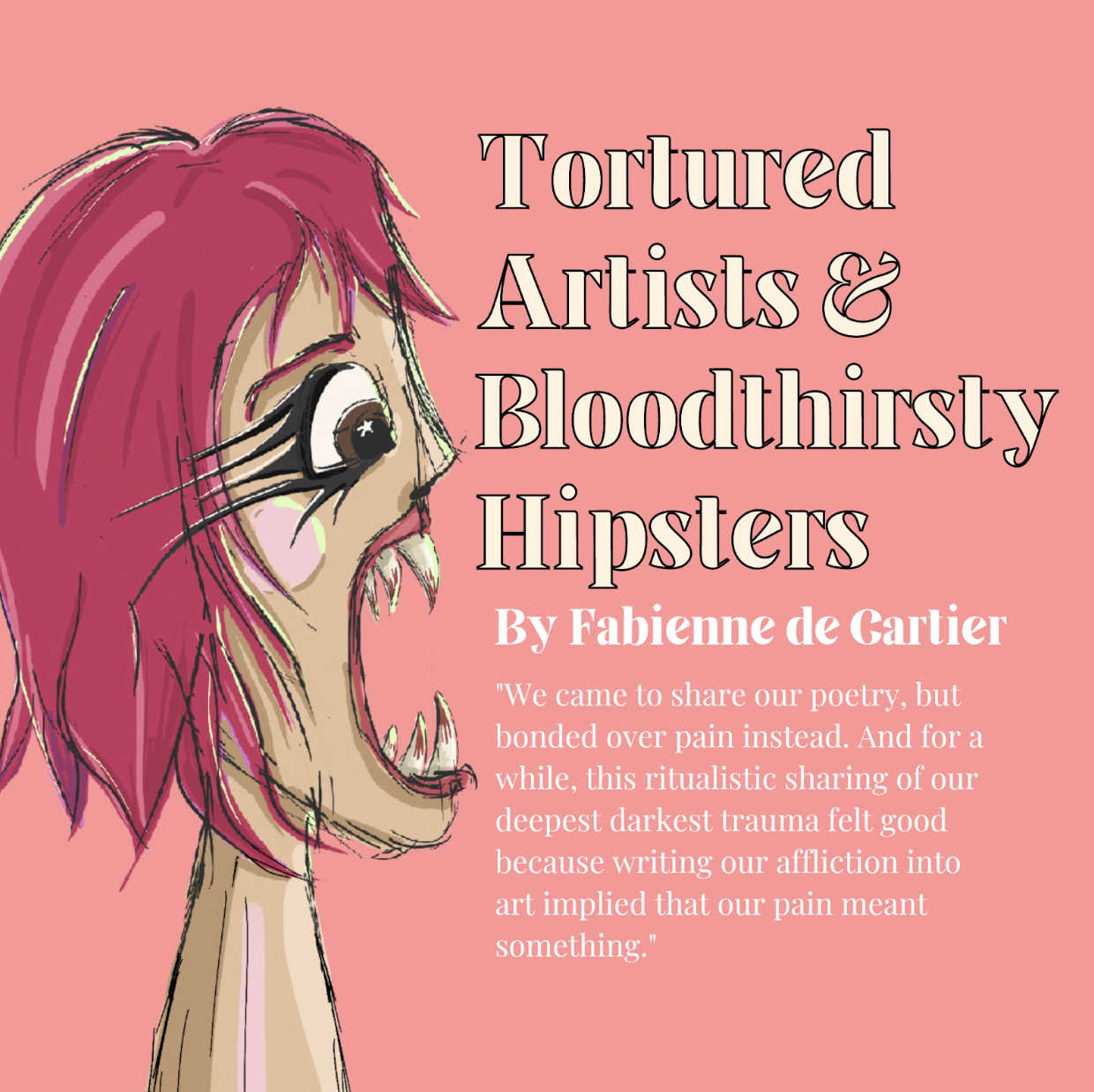
I started writing at thirteen when I got diagnosed with cancer and had to reconcile an existential crisis while hooked up to a cruel concoction of chemo and other drugs. Dazed as I may have been, I quickly found my way to poetry slams, sharing my sappy, rudimentary scribbles with other young poets. As simple as the poems were, they were the only way I knew how to express the profound strain of living in life/death limbo. The slams were a place we felt we could be ourselves, tell the tragic tales we usually hid from the world, and were applauded for it. We came to share our poetry, but bonded over pain instead. And for a while, this ritualistic sharing of our deepest darkest trauma felt good because writing our affliction into art implied that our pain meant something.
It took me a long time to realize how harmful this twisted version of healing was. Truth is, it didn’t heal at all. I’d see poets crying through words about wounds that had yet to scab over, and others rehearsing pain, opening old scars for the stage. Either way, we willingly wallowed in the hurt when we didn’t have to. Perhaps this is an inevitability as artists if we have to be in touch with our emotions all the time. But art and pain aren’t synonymous, and perhaps instead, we should demand of ourselves a more productive rendition. Perhaps all us trauma-bonding writers should adopt a literature and art culture that allow us to reconcile with and try to move on from our past, instead of forever live in it.
We need constructive art not just for our own sanity as artists, but for our audience’s because no matter how much they cheer for it, this detailing of trauma can be detrimental to them as well. Poems that dress up suicidal thoughts in flowery language only make suicide seem more appealing for those already struggling with it. In the same vein, according to the National Institute of Mental Health, in April 2017, suicide rates among US youth spiked 28.9% due to Netflix’s release of hit show 13 Reasons Why (“Release of 13 Reasons Why”). Maybe it’s because the show gave people a guide on how to do it, or maybe it’s because a boy falls in love with Hannah Baker, but only after she dies. And this kind of media is so accessible. Just a click away with the emergency room’s public wifi. [1]
Rarely is this harm intended by the artist, but the hurt happens anyway. For example, whether we attribute blame to cult classic director David Fincher for glorifying violence, or to the audience for their misinterpretation, Fight Club was meant to be a critique of toxic masculinity, but inspired fight clubs across North America instead (Newton). What’s difficult here is even if we recognize how our art affects us as artists, it can be hard to know how it will affect our audiences. If we cannot control how our work is interpreted, how much responsibility should we take on for its effect? Should we even take on any responsibility to make our art productive, or is honesty sometimes an antithetical and superior objective? It’s so easy to deny blame, ignore our influence, and go back to describing the graphic gore in painful detail. It’s so easy because audiences beg for it.
At every poetry slam I’ve ever been to, the more shocking the poem, the higher the score, and the most disturbing stories received standing ovations. The basement bars fill with a bunch of sadistic tote bag-carrying hipsters chanting for blood. And if the other poets are anything like me, they crave the validation even if they’re a little ashamed to. They perform the poems they’re best known for, even if it means reliving harrowing moments. Because validation is the fun part, but it comes at a cost. I wrote a poem about sexual assault a few months ago and my mentor reminded me readers would want the gritty specifics of my experience. But I kept the metaphors to guard me, to keep the trauma-ridden poem from being traumatizing. Maybe sometimes, we should resist giving readers what they want.
We humans have fiendish tastes. Our art and entertainment industry supply our steady cultural demand for vivid and vicious media. From gladiatorial combat to WBA championships, we have always had a proclivity for the horrific. Maybe we’re drawn to the high-stakes excitement, or the graphicness is the only way to make us feel compassion, or it's our penned in animalistic instincts that kick in. Whatever the reason, we should reflect at a cultural level on why we have such an inclination towards violent entertainment.
We writers should perhaps try to let our painful creations die with our pain instead of continuing to perform and market them. We should strive to write in a way that makes people feel less alone, instead of in a way that pushes readers towards violence and aggression. We should learn to deny readers’ demands if they come at the cost of our own wellbeing and the wellbeing of others. For all our callous and cynical tendencies, maybe it’s time we grow up and write responsibly.
Still, sometimes I can’t help myself. Sometimes, I crawl back to my bloodied notebook and write poems that romanticize trauma when I can’t bear the idea that all this hurt amounts to nothing. Maybe art can just be how we cope with all the tragic banalities we see around us. Maybe sometimes, we have to write our pain into poetry to make it poetic enough to live with, to make the world beautiful enough to live in.
Works CitedNewton, Matthew. “Inside the Gentlemen's Fight Club of Silicon Valley.” Thought Catalog, 10 Feb. 2011, https://thoughtcatalog.com/matthew-newton/2011/02/inside-the-gentlemens-fight-club-of-silicon-valley/.“Release of ‘13 Reasons Why’ Associated with Increase in Youth Suicide Rates.” National Institute of Mental Health, U.S. Department of Health and Human Services, 29 Apr. 2019, https://www.nimh.nih.gov/news/science-news/2019/release-of-13-reasons-why-associated-with-increase-in-youth-suicide-rates.The Lunar Cowgirl
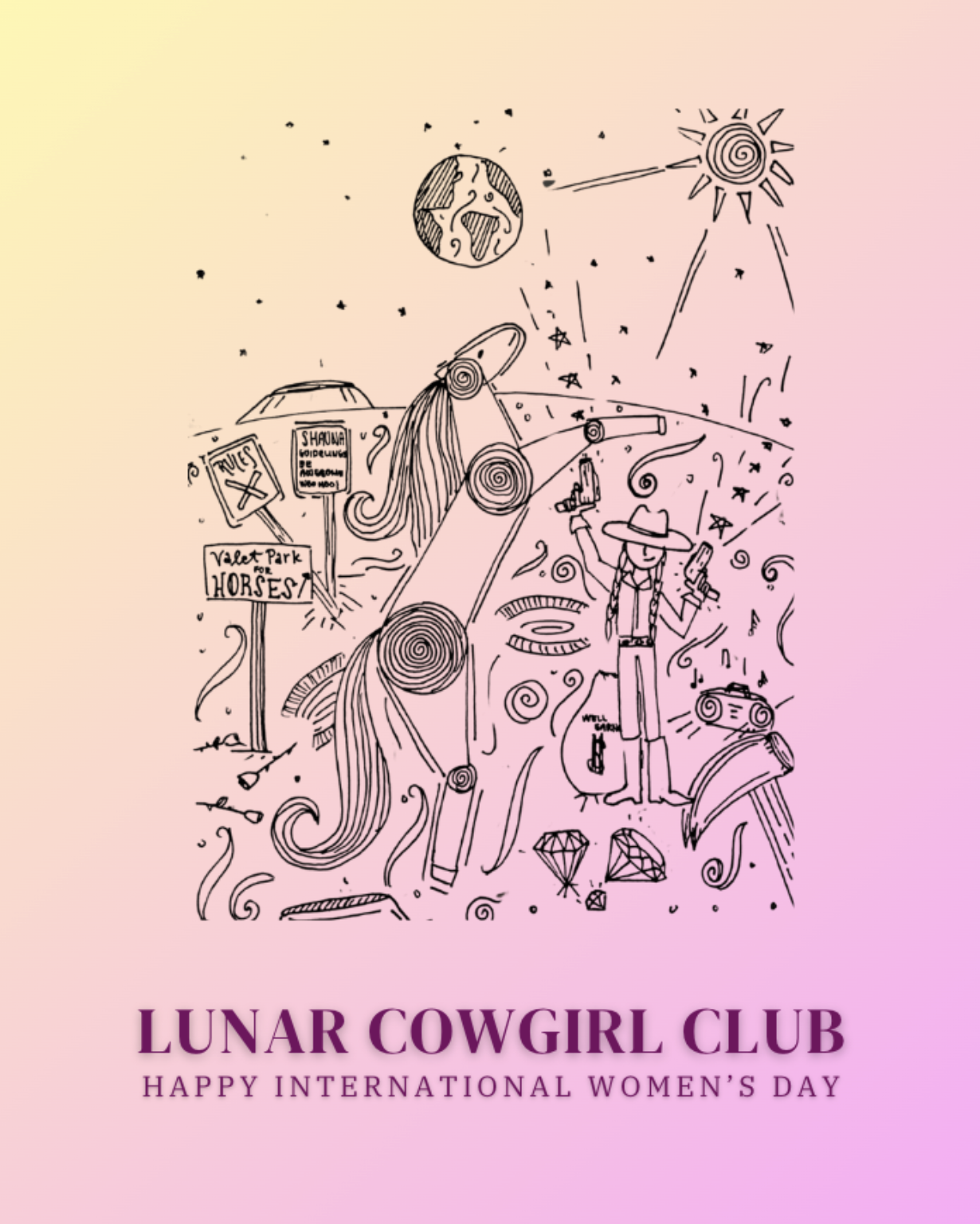
She kicks up nebula dust,
Spangled spurs cutting through the night
The dust don’t settle at the edge of the universe
Sparks catch fire in her flight
She rides with a lasso of Saturn’s rings,
A star-studded belt and sack full of jewels,
A comet tail tangled like silk in her braid
She answers to nobody’s rules
She rides past rivers of silver and starlight,
Where cosmic leviathans stir and splinter
Time and space will bend to her stride
On her long, fateful journey to the center
She rides through wreckage, past dust and decay
The old world crumbles in the wake of her reign
And with hands torn raw from the weight of the reins,
She breaks what the sheriff swore would bind her
She struts into the interstellar rodeo
As the solar winds howl and the stars whisper her name
She tips her cap low like a waxing crescent moon
And stakes her claim in the cosmic hall of fame
Her chrome mare enters the ring, all shimmer and steel,
As she stares down the barrel of her sparkly six shooter
The cosmos bends to her piercing, steady gaze
As she declares, “I can live forever!”
She shoots stars into the night
And the sky splits apart in brilliant wonder
Bringing glitter and glamour to the dusty deserts,
She tears the old firmament asunder
The heavens crack and the stars burn bright
As the lunar cowgirl brings forth a new dawn
It’s the end of an era at the edge of the universe
And all the cowboys hear her celestial song.
Written by Fabienne de Cartier in February 2025 as a commissioned work for International Women’s Day. It was adapted from a poem she wrote for her mother in 2019.